Designing a Career Copilot:
Defining Human–AI Collaboration from 0→1
Role
Founding Product Designer
Company
Spotly (Previous AMA Career)
Project Timeline
10 weeks (Design)
Contribution
Strategy, UX, UI, Visual
Project Overview
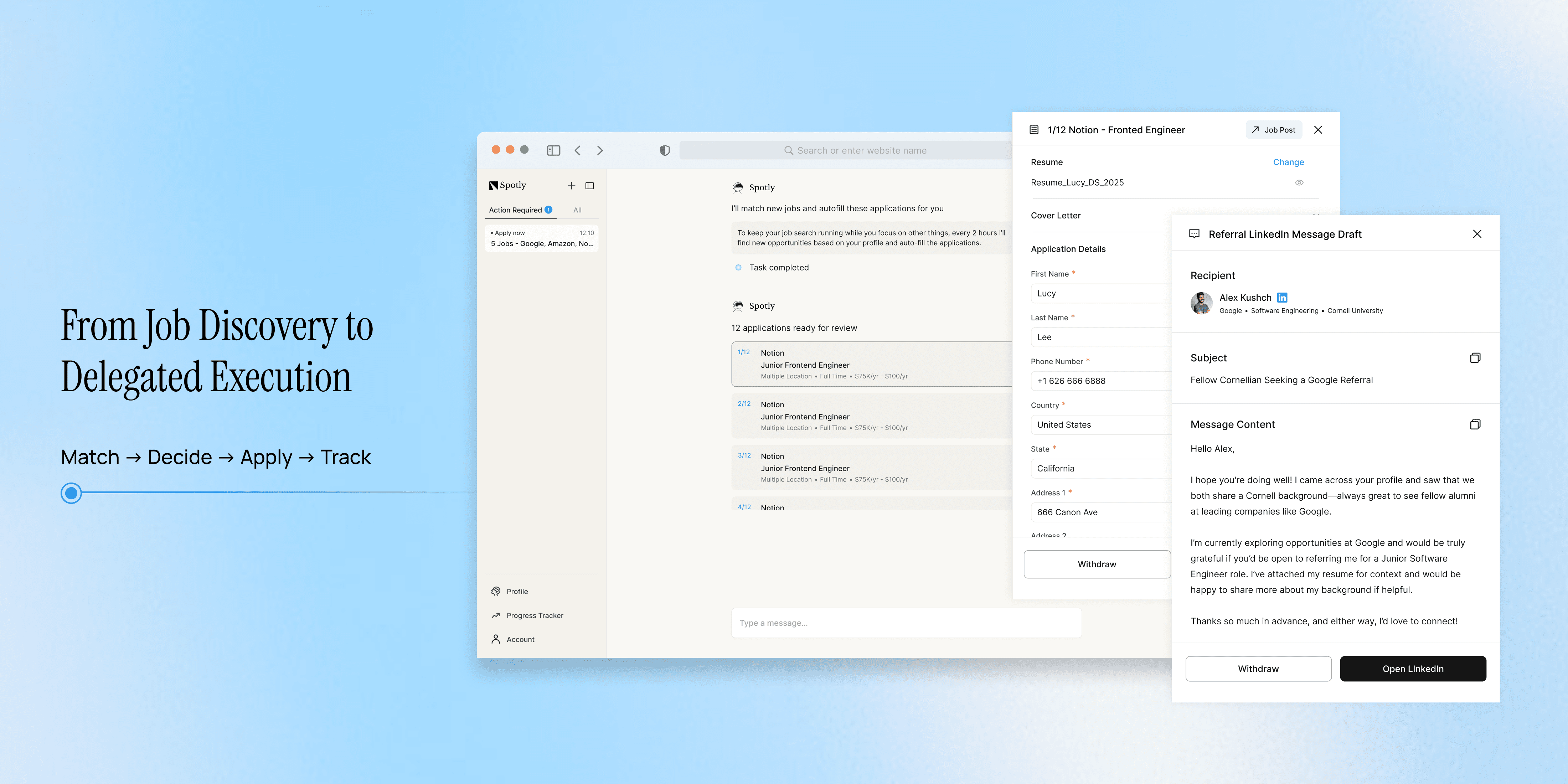
Spotly is an agentic AI product designed to reduce the manual burden of job searching—by matching roles, preparing applications, and executing repetitive tasks on users’ behalf.
I joined as the founding product designer and led the end-to-end design of a production-ready, launch-ready product under tight timelines and high uncertainty. This work focused on defining how users and AI collaborate in real workflows—not as a concept demo, but as a system intended for real usage and long-term iteration.
Why This Product Mattered
This product played a critical role in Spotly’s early fundraising. The goal was to ship a fully usable, production-ready product that could support real job search outcomes while validating the core agentic model.
The product was designed to be launch-ready from day one, enabling internal and early users to actively use it in real job searches. These real-world outcomes supported conversations with a top-tier VC list and validated both the product direction and its readiness for scale.
Outcome & Impact — Quick View
Key outcomes that reflect system design, execution speed, and trust validation.
0→1 production-ready product in 10 weeks
Designed for real usage, not proof-of-concept, with clear paths for iteration and scale.
Attract Angel & Top-Tier VC Interest
Secured investor from Google DeepMind leadership, received a pre-seed term top-tier VC sheet.
Defined an Agentic UX system
Established task-based agent interaction patterns covering autonomy, approval, fallback, and learning.
Validate with Beta User Outcomes
Early beta testing showed strong user satisfaction, with several users advancing to interviews and offers within weeks.
Context & Design Framing
Spotly was built in a highly ambiguous environment, with evolving AI capabilities and shifting requirements. The real challenge wasn’t execution—it was defining how users and AI should collaborate in real workflows.
As the founding product designer, I treated design as a tool for making decisions under uncertainty: framing interaction hypotheses, translating AI behaviors into controllable experiences, and using rapid prototypes to test assumptions and align the team. Every decision balanced speed, trust, and control.
Key Design Decisions
Deciding When AI Acts — and When Humans Stay in Control
One of the earliest tensions was how autonomous the agent should be. Full automation was technically possible and attractive from a product narrative standpoint, but early assumptions quickly showed a risk: users were excited by speed, yet uneasy about handing over irreversible actions. Moving too fast could easily break trust before value was proven. I chose to treat autonomy as conditional rather than absolute—allowing the AI to prepare and progress tasks on its own, but pausing at high-impact moments for user approval. This compromise preserved momentum while making responsibility boundaries explicit, helping users feel in control without slowing the system to a halt.
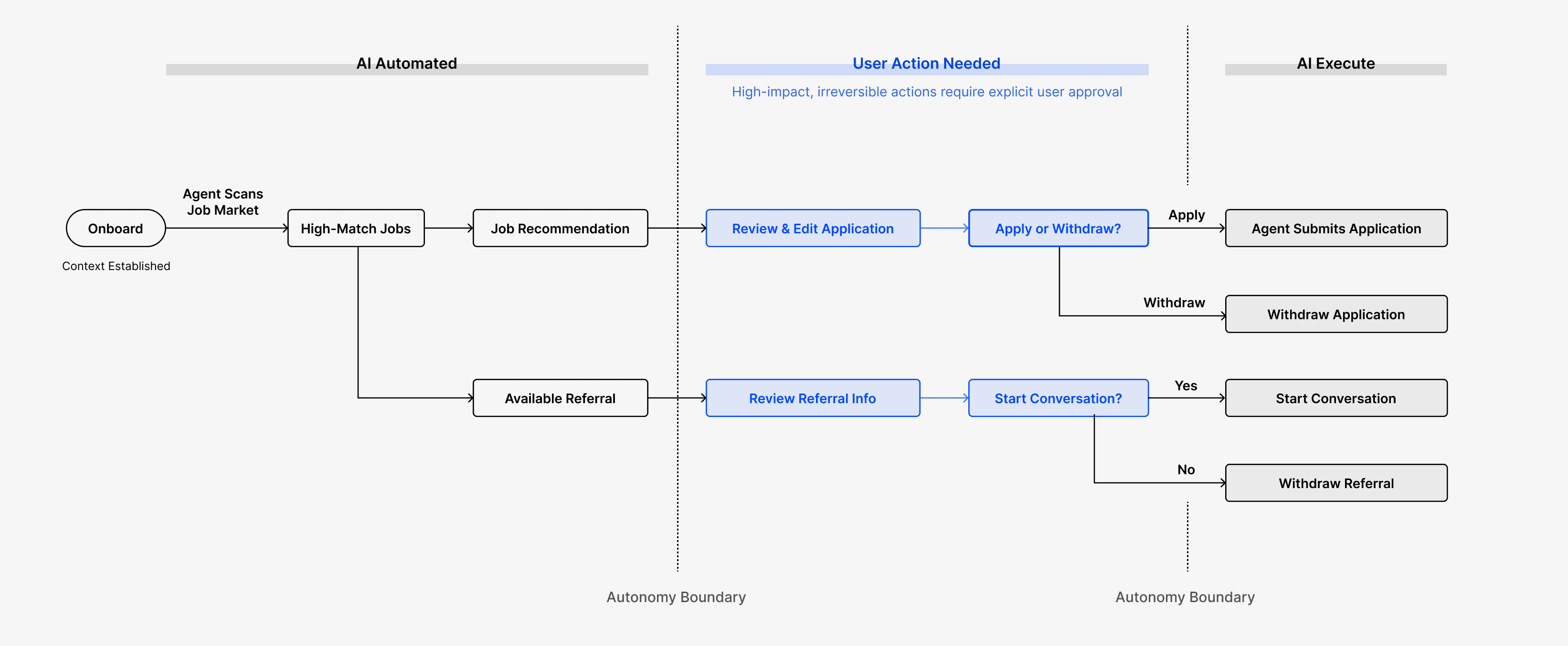
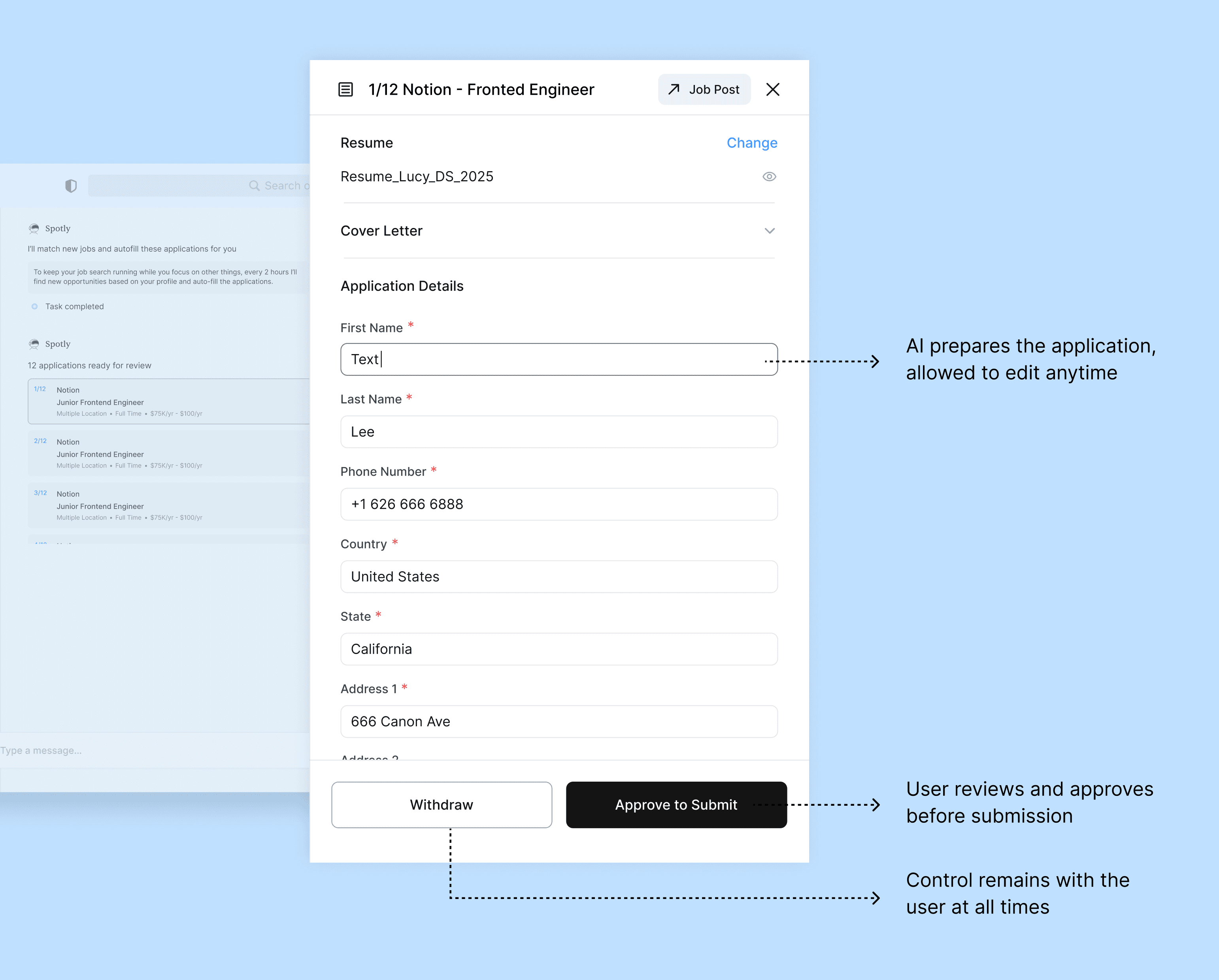
The agent prepares the application autonomously, but submission only happens after explicit user review and approval—ensuring speed without sacrificing trust or accountability.
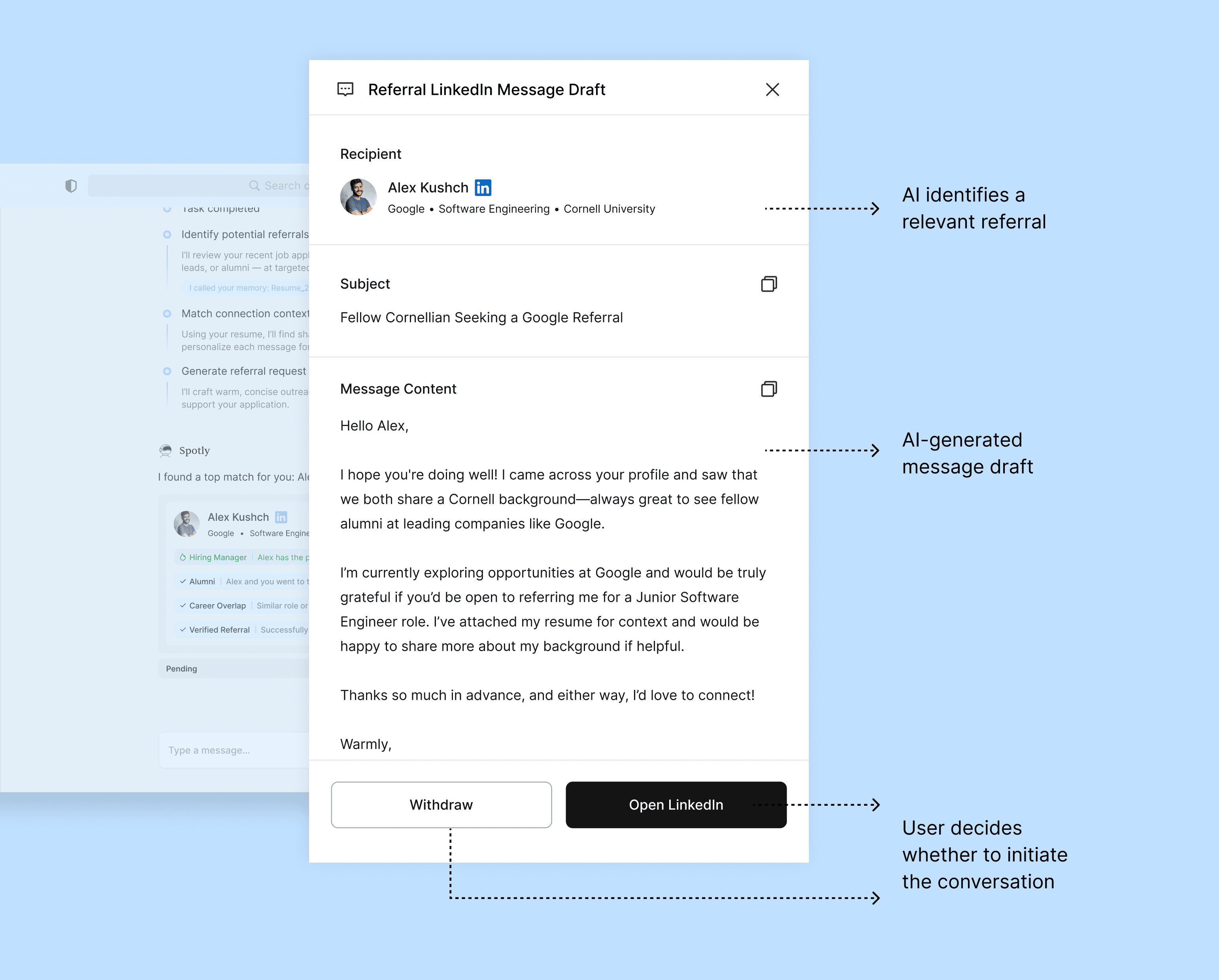
Spotly assists by identifying opportunities and drafting outreach, but leaves the final decision and action to the user—preserving trust in socially sensitive interactions.
2. Making AI Actions Visible Before Execution
Another conflict emerged around transparency. Hiding intermediate steps reduced cognitive load, but it also made the AI feel opaque and unsafe. When users couldn’t tell what the system had already done—or what it was about to do—approvals felt like blind trust rather than informed consent. I deliberately traded UI simplicity for clarity by surfacing structured action logs that showed what was analyzed, what was generated, and what would happen next. While this added interface complexity, it transformed transparency into a functional part of the workflow, allowing users to review, intervene, and proceed with confidence.
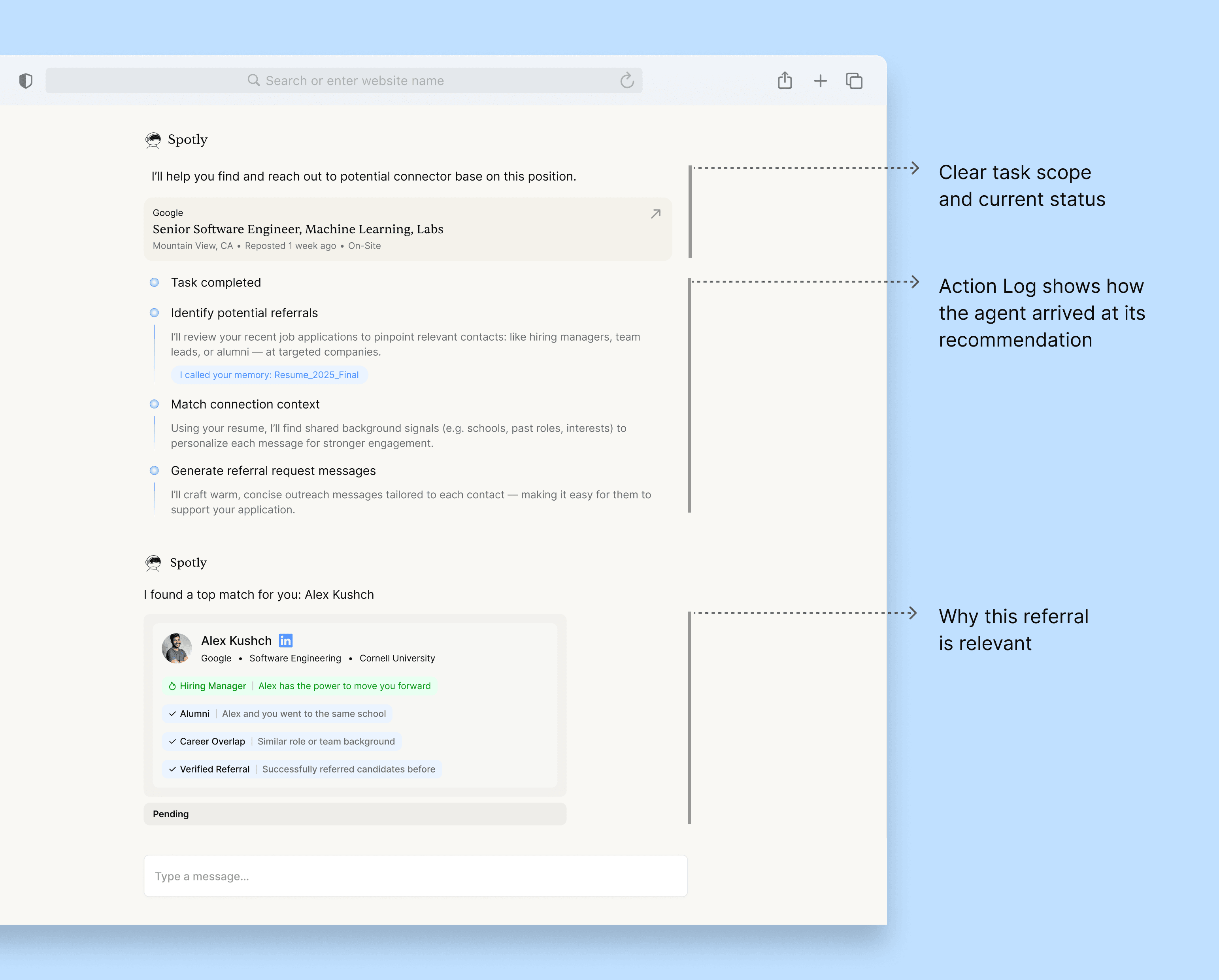
By exposing task status, reasoning steps, and selection signals, Spotly allows users to understand, evaluate, and trust AI decisions—without requiring them to inspect raw data or model logic.
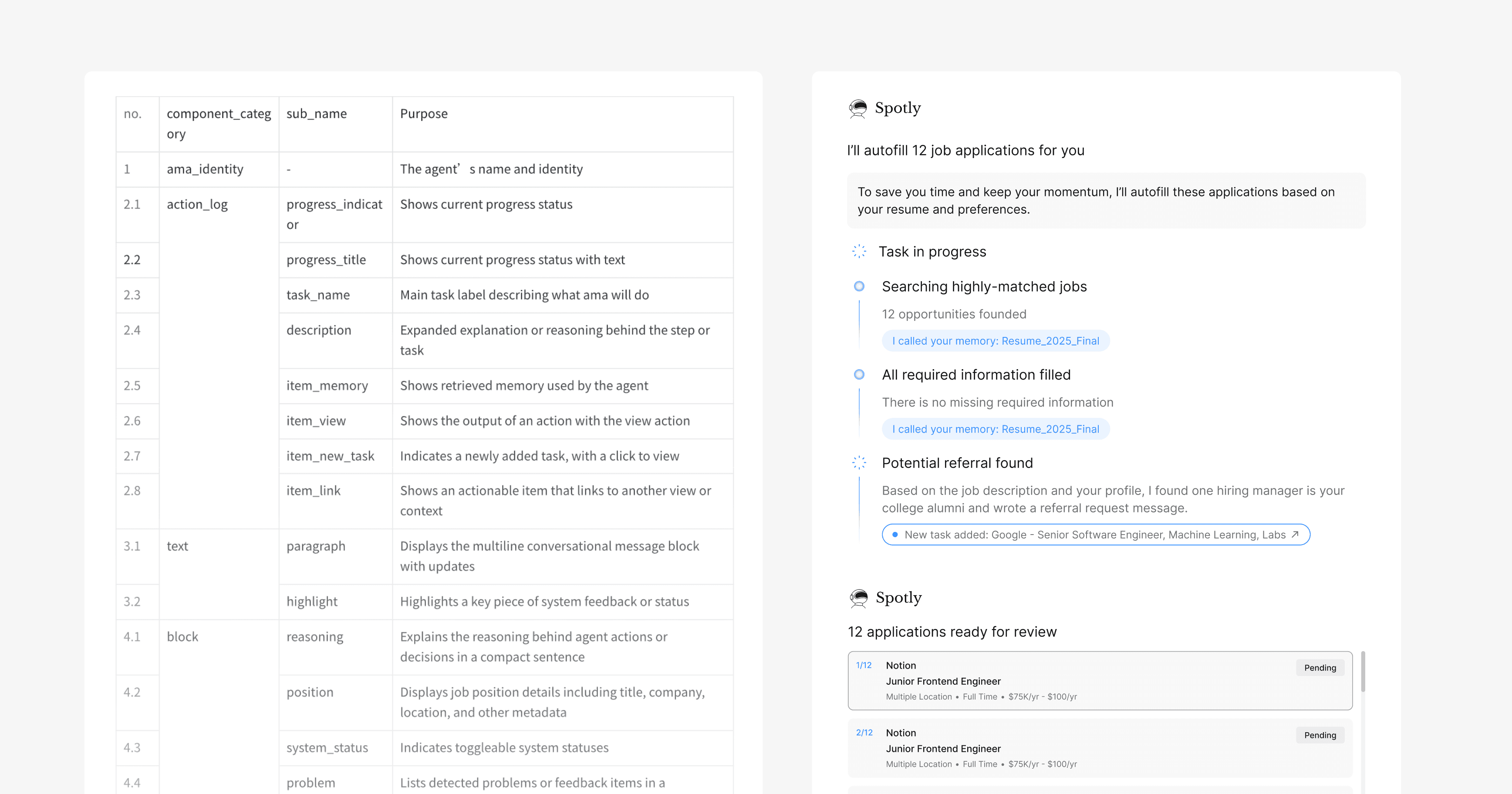
Left: The system that governs how those messages are constructed
Right: How the agent communicates in practice
3. Defining What the AI Truly Needs to Know
There was constant pressure to collect more data upfront to “make the AI smarter,” but long profile setup created friction and delayed users from reaching value. I reframed the problem from data completeness to decision relevance. Instead of asking users to manually fill out extensive profiles, we allowed them to import core career data via a LinkedIn URL—capturing high-signal information instantly and moving users directly into job matching. Additional inputs were requested progressively, only at moments where specific information was required to complete a task, while users could always edit their profile manually. This approach reduced onboarding friction while ensuring the agent had the right information at the right time.
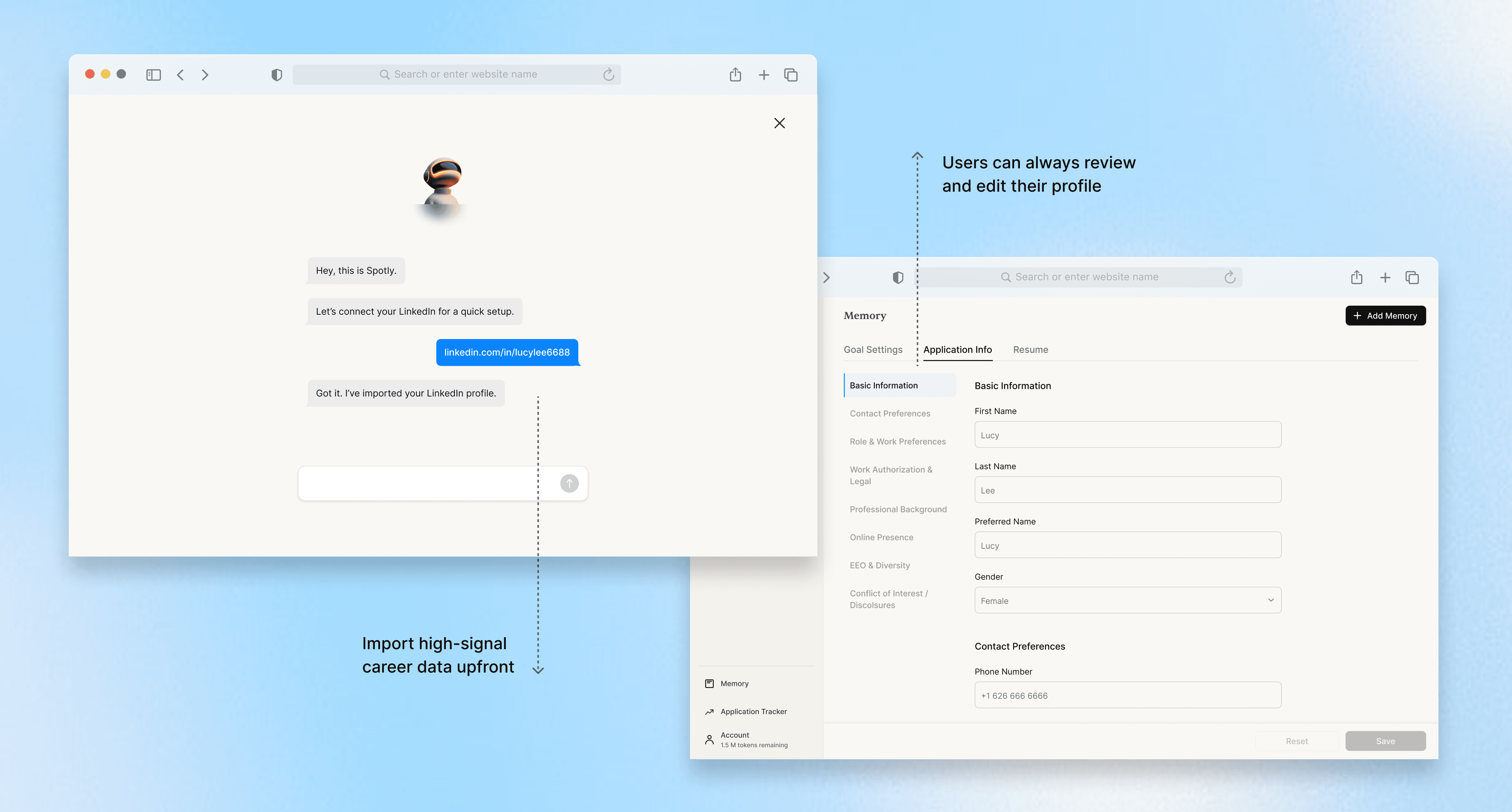
By importing high-signal career information upfront and requesting additional details only at critical moments, Spotly minimizes onboarding friction while ensuring the agent has the right context at the right time.
4. Giving Users a Clear View of Their Application Progress
As automation scaled, users quickly lost track of what work had already been done on their behalf. Applications were prepared, submitted, and followed up across different roles, but without a centralized view, users struggled to answer a basic question: “Where do things stand right now?”
To address this, I designed a progress view that surfaced the full lifecycle of each application—what resume was used, which roles it was submitted to, current status, and pending next steps. By consolidating past actions and ongoing work into a single, scannable overview, this feature helped users regain clarity over their efforts and confidently understand the outcomes of the work they had already invested in.
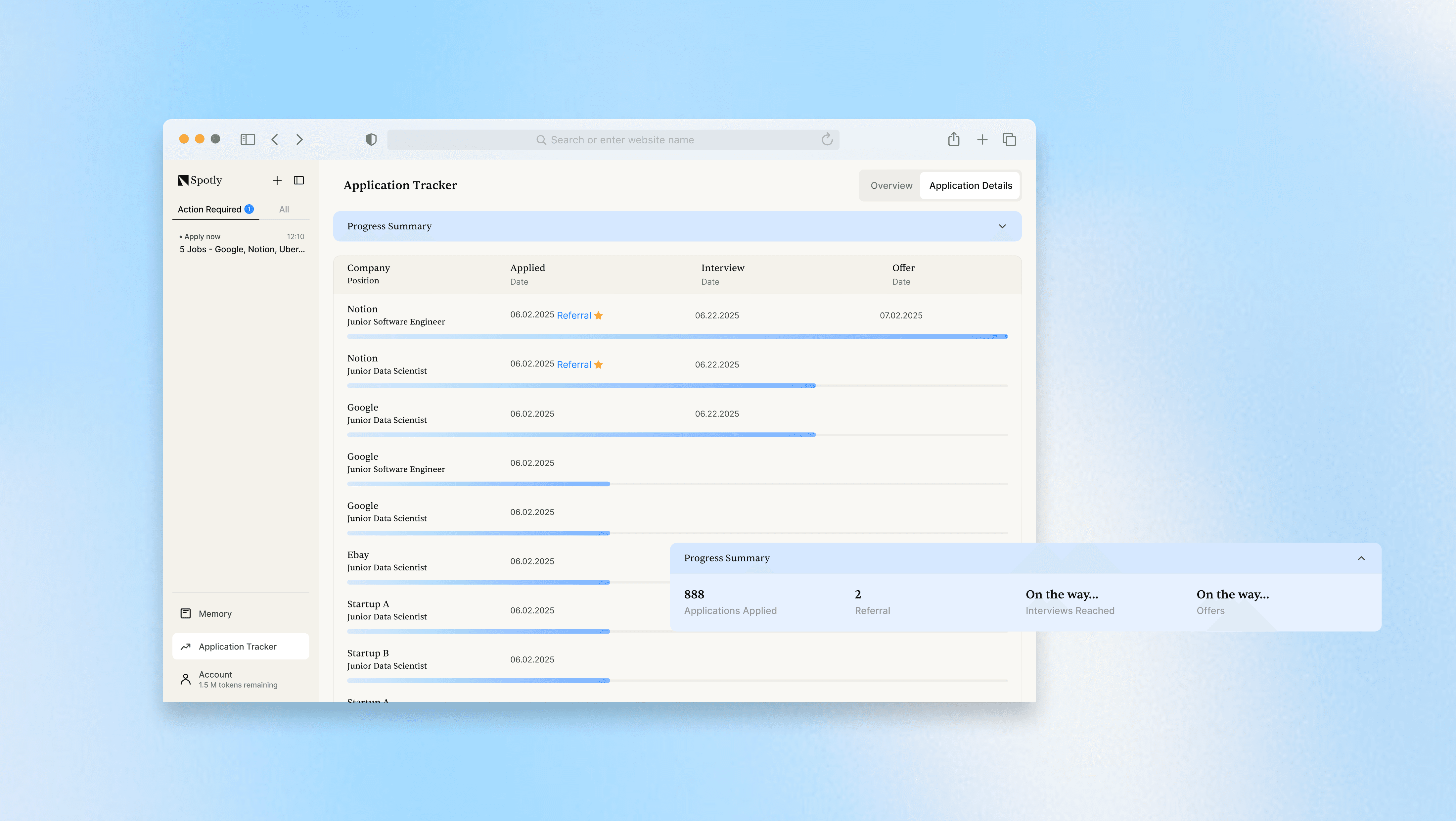
Progress Tracker
What's More: Designing for Long-Term Career Memory — Without Overbuilding Early
As we thought beyond the MVP, we framed Spotly not just as a job-search tool, but as a long-term career copilot—one that could support a user across multiple job changes, role transitions, and career milestones. That vision required memory. Career-related artifacts—resumes, notes, reflections, and past decisions—needed to persist over time and inform future actions.
However, fully realizing this vision early would have added significant complexity and risked distracting from core validation. As a compromise, I introduced a lightweight Memory tab in the current version, allowing users to upload career-related materials and view AI-generated summaries through TL;DR. This design planted the foundation for a memory-driven agent while keeping the initial experience focused, scalable, and easy to evolve as the product matured.
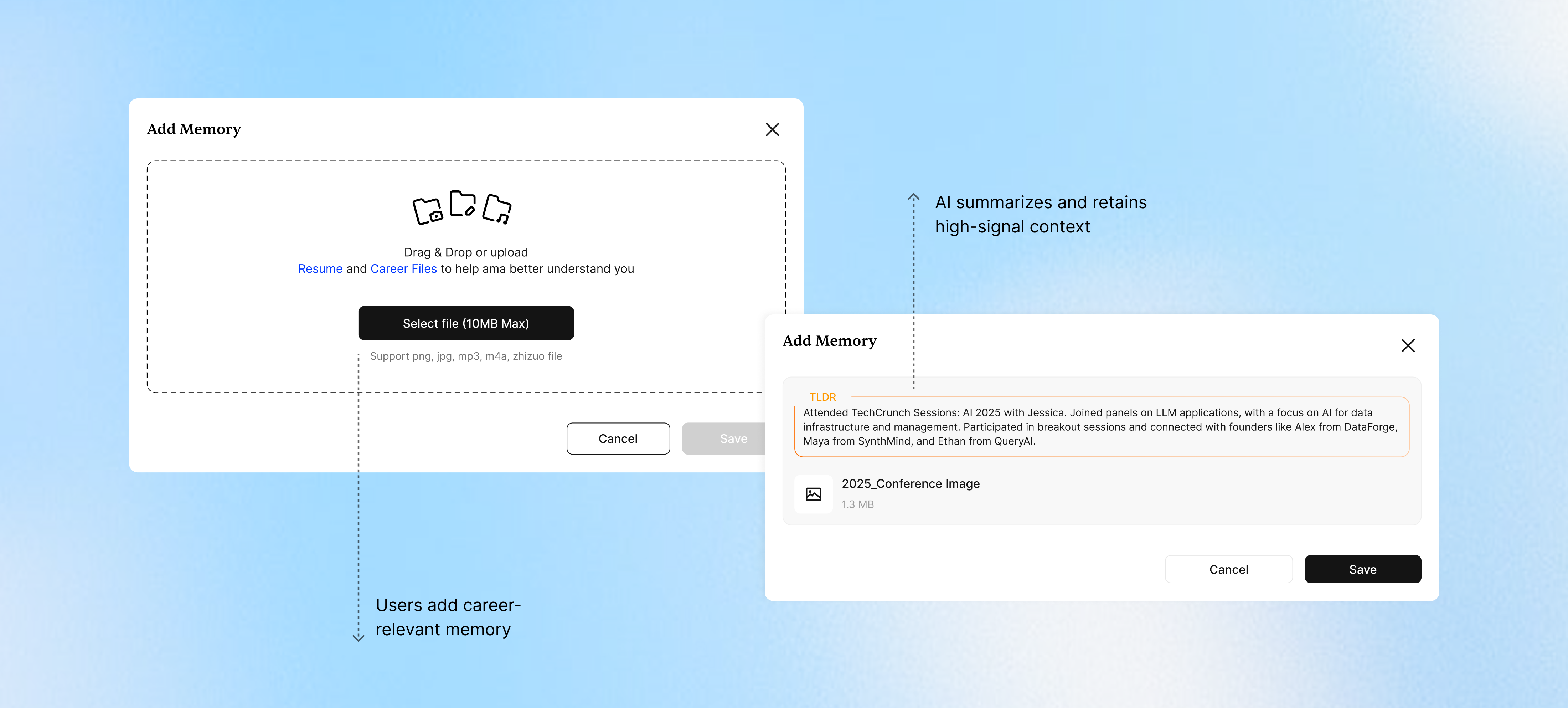
By allowing users to store career-related memories and surfacing AI-generated summaries, the system begins to accumulate context over time—while keeping the current experience lightweight and focused.
Reflection
Designing a 0→1 AI product meant working without a clear playbook. I was constantly making calls in ambiguous situations—iterating quickly, crafting carefully, and aligning with stakeholders along the way.
Looking back, the hardest part wasn’t designing automation, but deciding where restraint mattered more than intelligence. I had to think carefully about when the agent should act, when it should pause, and how its actions stayed understandable and under user control.
What I’m most proud of isn’t just the features we shipped, but the interaction model that emerged—one where AI could move fast without overstepping, and where users felt comfortable trusting the system to act on their behalf.